

Steal these brilliant growth tactics (part 2)
Breaking down my new favorite examples from Lovable, Clay, Typeform, Decagon and more

👋 Hi, it’s Kyle and I’m back with a new Growth Unhinged, my newsletter that explores the unexpected behind the fastest-growing startups.
I love to get inspired by what others are doing. It sets aside existing constraints and gets the creative juices flowing, inspiring dreams of what if…
Last year I shared my favorite growth tactics based on my experience signing up for 100+ self-serve products ranging from Asana to Zapier. In the 12 months since then, I’ve tried out a whole lot more (with an emphasis on AI-native apps) and have learned from some of the smartest operators on the planet through this newsletter.
I wanted to devote today’s Growth Unhinged to highlighting the best of the best: my favorite retention move (ChartMogul), unconventional growth tactic (Clay), growth job description (FirmPilot), in-app upgrade prompt (Typeform)… even my favorite application of vibecoding for growth (Lovable).
I hope these examples inspire your next growth experiment. After you’re done reading, join the conversation on LinkedIn and share your own go-to faves.
Favorite retention move: ChartMogul
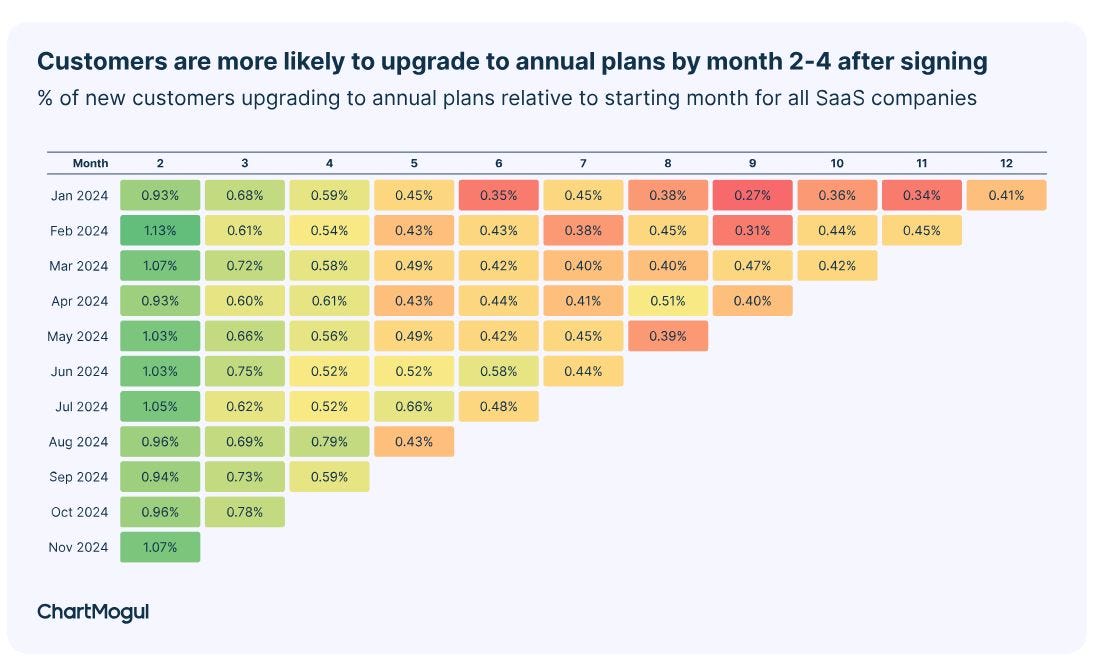
I used to think you'd want to give customers some time to experience the product, then push for an annual upgrade in months 6-12.
Turns out the opposite is true. Customers are 3-4x more likely to upgrade in month 2 than they are in month 9.
And the upgrade is valuable. Median net revenue retention on monthly plans ranges from 43% (<$25 products) to 76% ($250-$500 products). It's about 10-20 percentage points higher for annual plans.
The data comes from my friends at ChartMogul who looked at the billing practices of 2,500+ SaaS companies. (Yes, I'm jealous of their dataset!)
What to do with this data:
Make sure customers are able to not only activate in the first 30 days, but they're able to build a habit around your product. If they're not seeing value, a nudge to upgrade from monthly to annual will fall flat.
Ask for the annual upgrade much earlier than you think. You can (and apparently should!) start campaigns toward the end of the first month.
Push for annual not just as a discount but as making an investment in the product. Of course, the discount is a motivation, but people already knew you offered an annual discount when they signed up. Shifting the mindset towards making a smart investment puts the customer in a different frame of mind.
Keep offering a monthly plan, especially in the early days. Turns out that companies with a meaningful share of their customers on monthly plans (50%+) are growing faster than others, especially during the journey from $0 to $10M ARR.
Favorite in-app upgrade: Typeform
I went to buy a new Typeform subscription last week (👀). After choosing a plan and checking out, I already agreed to a future upgrade. And, no, it wasn't because they made me jump through hoops.
Typeform — like more and more companies — has a hybrid pricing strategy. They charge a subscription fee, but the subscription price goes up the more you use it. In Typeform's case, the price is tied to the number of monthly survey responses you collect.
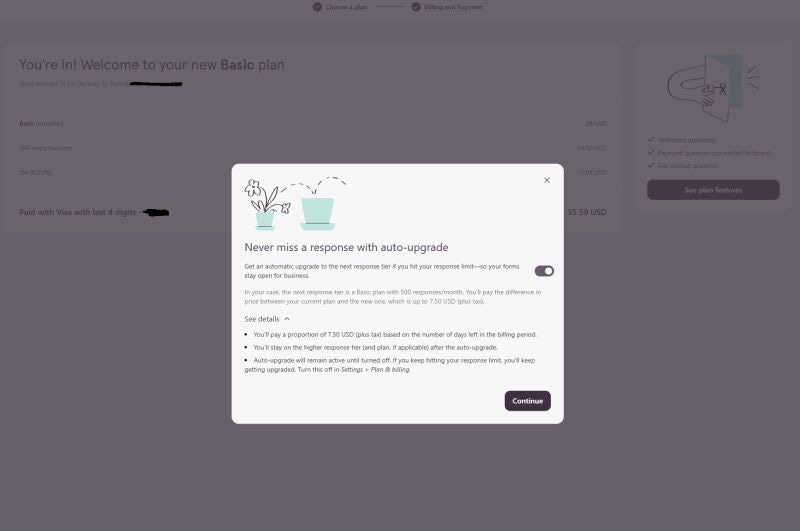
It sounds complicated, but Typeform makes it easy. Typeform drops in this screen after checkout: "Never miss a response with auto-upgrade."
What I love about their approach:
It felt like they were doing me a favor. The prompt came across as helpful, not sales-y. Of course, I'd want my surveys to stay open so I don't miss a response. Language like "get an automatic upgrade" sounds far better than "pay more or you lose your data". And I just needed to set the toggle to "on".
They created loss aversion. Anyone who's sent out a survey knows that getting responses takes a ton of work. I'd hate to feel like that hard work was wasted if I'm getting more responses than I thought. Paying an extra $7.50 for 250 more responses ($0.03 each) came across as a bargain to have the peace of mind.
It was transparent. In a small amount of copy, Typeform told me exactly how much more I'd pay, when I'd pay it, when it would be billed, and how I could downgrade. (Once an upgrade happens, it stays on unless you proactively turn it off.)
PS: The survey in question? My inaugural State of Monetization survey. Whether you’re a SaaS or AI company, I want to hear from you! The survey will take about 5-10 minutes and provide an important pulse on evolving pricing models.
Favorite unconventional growth tactic: Clay
Keep reading with a 7-day free trial
Subscribe to Kyle Poyar’s Growth Unhinged to keep reading this post and get 7 days of free access to the full post archives.