



Should you buy a media company? 🎙️
Why SaaS companies need a media strategy – and how to do it

👋 Hi, I’m Kyle from OpenView and welcome to my newsletter, Growth Unhinged. Every other week I take a closer look at what drives a SaaS company’s growth.
Earlier this year Pendo acquired Mind the Product, the world’s largest destination and community for product folks.
Odd, right? What does a SaaS unicorn want to do with a 20-person media and community site?
At first glance, this type of bet seems like a distraction and a sign that too much money has poured into the startup ecosystem in recent years. 🤑🔥
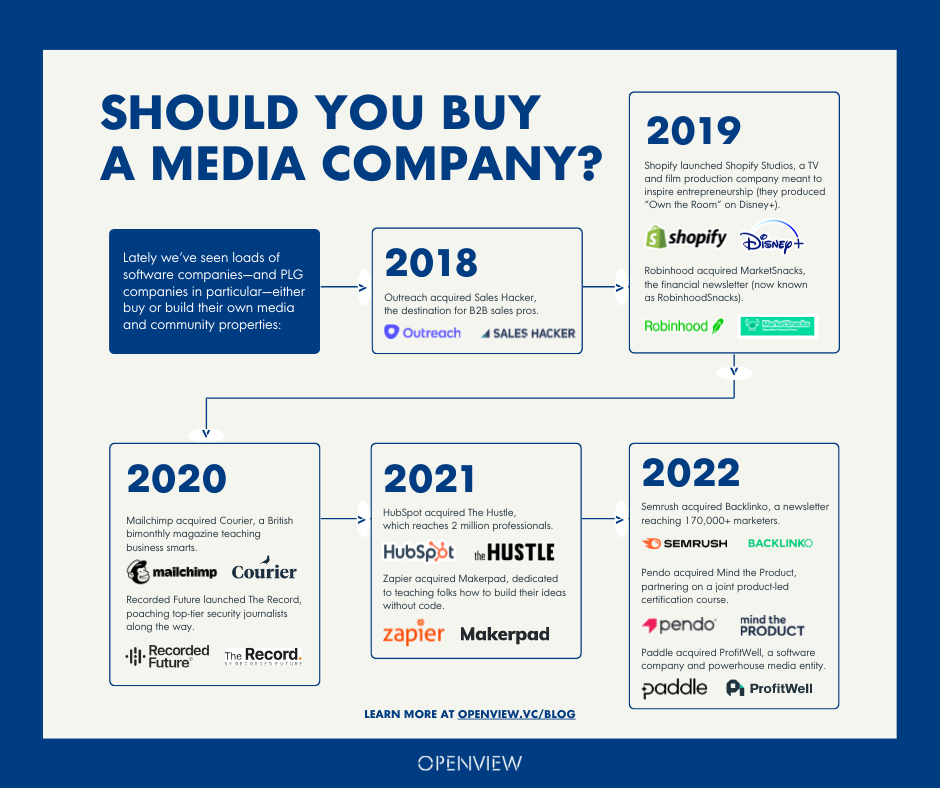
But Pendo isn’t an outlier. Lately we’ve seen loads of software companies—and PLG companies in particular—either buy or build their own media and community properties:
HubSpot acquired The Hustle, which reaches two million professionals.
Paddle acquired ProfitWell, a software company and powerhouse media entity.
Semrush acquired Backlinko, a newsletter reaching 170,000+ marketers.
Mailchimp acquired Courier, a British bimonthly magazine teaching business smarts.
Shopify launched Shopify Studios, a TV and film production company meant to inspire entrepreneurship (they produced “Own the Room” on Disney+).

HubSpot Co-Founder and CTO Dharmesh Shah summed up the sentiment well. “Next-gen software companies will have a media company embedded inside,” he tweeted in October 2020.
Along with my colleague Sanjiv Kalevar, partner at OpenView, I investigated why SaaS companies are racing to acquire media assets and how to make these acquisitions successful. Let’s dive in.
The rationale: why software companies want to have a media company embedded inside
👉 Third-party media companies have cracked the code on attracting a large and highly engaged audience for very little cost.
Mind the Product reaches 300,000 product managers, designers, and developers. They manage conferences, content, newsletters, Slack groups, meetups, workshops, and more. Oh, and all of that is done with a staff of just 20. That's hard for any SaaS company to match in-house.
Meanwhile, unlike SaaS companies, media companies often struggle to monetize their audience on their own. This makes them less expensive (low cost to buy) despite being strategically valuable. The result is a win-win.
👉 Media and community can be an incredible multiplier on a PLG strategy.
In PLG businesses, you're trying to add value for the end user and not just the executive buyer. It can be hard to reach end users with traditional growth tactics like outbound calling, paid ads, etc. That’s especially true as audiences change their content consumption behavior and competitors latch on to the same tried-and-true marketing practices. Why not get your brand in front of users where they already hang out?
👉 Vibrant user communities help just about every function of a SaaS company.
There’s been tremendous buzz about community-led growth as an accelerator to a PLG strategy. The best companies have a vibrant community around their products (see Figma, Notion, Airtable, Webflow, etc.).
Peer communities are particularly important if you’re reaching a targeted audience (for example, a specific industry vertical or new user persona). You can play the role of educating and connecting these folks, which in turn helps nearly every function of your business.
These types of communities reach new audiences who are highly qualified because they've interacted with current users. They create stickiness by increasing the switching costs associated with changing vendors. And they make users more successful with adopting your product for more and more use cases.
Six insights for acquiring a media and community asset
Insight #1: These acquisitions are low-risk bets on an uncertain future
If you consider the size of the acquirer relative to the cost of the target, one thing becomes clear: these are relatively low-risk bets. HubSpot reportedly spent $27M on buying The Hustle—a fraction of the company’s current $13B market cap (0.2% to be exact). These bets get even less risky if you pay mostly with stock rather than cash.
Big SaaS companies with billion dollar valuations can afford to treat media acquisitions as experiments and as an insurance policy against uncertain future outcomes. They don’t necessarily need to build a comprehensive business case with board-approved targets in order to get the green light on an acquisition. These types of acquisitions haven’t been proven out yet among earlier stage (Seed-Series C) or more cash-constrained companies.
With that in mind, the acquisition thesis tends to be centered around go-to-market efficiency and bringing strategic hires into the company.
Do you buy into SEO getting more challenging and harder to rely on?
Or that paid ads will become even more saturated, especially with Apple’s rules on app-tracking transparency?
Or that you need someone on your team who’s seen as highly influential among your target customer base?
If so, you might be inclined to take out an insurance policy on an uncertain future.
Insight #2: Buying is normally better than building
The alternative to buying a media asset? Building it yourself, as Shopify, Recorded Future and ProfitWell have done.
That said, building an in-house media company can be expensive, time- consuming, and failure-prone.
Expensive: Marketing leaders we spoke to estimated that building these media assets in-house would cost a minimum of $1.5 to $2 million. And there’s no guarantee this investment would generate an audience, let alone business value.
Time-consuming: An audience doesn’t appear overnight. It needs to be earned through high-value assets, word of mouth, and sticking with it. Anyone who has launched a podcast knows that an audience doesn’t arrive overnight.
Failure-prone: While we can point to outliers (hello, ProfitWell’s media strategy), the average SaaS company doesn’t have the resources, capabilities, or mindset to do this in-house. There are too many shifting priorities as well as pesky internal stakeholders looking to convert your audience into customers.
All of a sudden acquiring an established media property starts to look like a safer choice.
“No one's really done this before in B2B. I don't know if we're really going to crack the perception of people only wanting one email per week. Will we get binge-ing? Even if we get both of these, is there enough distribution to justify continuing the effort? These are all important questions we'll need to figure out.” - Patrick Campbell on ProfitWell’s media strategy
Insight #3: Get comfortable with imperfect attribution
Let me channel your CFO: how will we prove whether this acquisition generated a positive ROI? 📊
Sure, you could point to metrics like influenced pipeline, referral traffic from the media asset, or cost per lead. But expect to be disappointed if you want to prove attribution beyond a reasonable doubt (the dark funnel strikes again!). Attribution gets even harder the more you maintain independence between the two entities.
Our suspicion: if SaaS companies could solve this attribution problem, we’d be seeing folks pay a lot more for media assets.
Just because you won’t have perfect attribution doesn’t mean you shouldn’t attempt to measure the impact of the acquisition. This should start during the diligence phase as you evaluate assets. Here’s how to de-risk an acquisition:
Test before buying: this usually starts with being a sponsor or partner
Check the audience overlap to determine the fit with your target audience as well as the incremental reach to be gained
Measure the value of that audience relative to alternative ways of reaching it
Validate the P&L to understand the operating costs and potential ongoing expenses to maintain or grow the property
Insight #4: Do what it takes to keep key employees
Media properties tend to live or die on the basis of one or two key employees. These strategic “acqui-hires” are critical to continuing to innovate on the media strategy. They’re extremely influential and trusted within your target audience. And they bring new skills, DNA, and expertise to your company.
Here’s how you keep them.
The obvious retention tool: earnouts (aka golden handcuffs). You’ll want these critical hires to vest over three or four years so that they’re highly financially motivated to stay with you.
The less obvious tool: culture and reporting structures. These key leaders are accustomed to being their own bosses. You’ll want to give them independence and make sure they’re excited about the projects they take on. This extends to reporting structures, too. You may see better results if these folks report to a neutral leader (ex: head of strategy) rather than the CMO so there’s less pressure to generate immediate pipeline.
Insight #5: When it comes to neutrality, actions speak louder than words
Independence is the lifeblood of media companies. The audience needs to believe that they’re neutral and trustworthy. If you’re buying an audience, your biggest fear is that the audience walks out the door right after the acquisition closes.
Actions speak louder than words when it comes to demonstrating independence. Is the parent company still sponsoring other communities? Have you retained the media company’s editorial team and given them creative control? Does the media asset still talk about competitors and remain open to competitor sponsorships (even if the competitors themselves decide to opt-out)?
All that said, if you look closely you’ll notice that SaaS companies find creative ways to bring the two entities together without killing the media asset. The starting point tends to be for the SaaS company to be the default sponsor for content, podcast episodes, events, and so on. It goes deeper from there. Here are three examples:
The navigation bar of The Hustle links out to HubSpot’s blog and prominently displays HubSpot’s logo.

Pendo partnered with Mind the Product on a joint product-led certification course, which got promoted to both audiences. This course builds on what Mind the Product is known for while creating a bridge for Mind the Product’s audience to discover Pendo.

Courier, traditionally a print magazine, can be found digitally on Mailchimp’s parent domain (https://mailchimp.com/courier/). This helps attract a large audience for Courier while putting Mailchimp’s brand front-and-center as the presenting sponsor.
Insight #6: Grow the media asset, don’t just maintain it
You’re buying an audience and that audience’s attention—not the content itself. It’s in your best interest to keep that audience vibrant and growing. If it’s growing, sponsors will want to keep investing and you’ll have more potential influence for your brand. Track KPIs like audience size, rate of contributions, and engagement rather than just the impact to your software business.
Consider the long-term potential here. Your media asset can meaningfully grow your addressable market by teaching your target users how to get better at their job and how technology can help them be more effective. What’s not to like about that?
The TL;DR on media and PLG
These acquisitions are low-risk bets on an uncertain future.
Buying is normally better than building.
Get comfortable with imperfect attribution.
Do what it takes to keep key employees.
When it comes to neutrality, actions speak louder than words.
Grow the media asset, don’t just maintain it.
Every bit here resonates. This didn't make much news but Amplitude also bought Data-led Academy, a side-project of mine that had pretty decent traffic. They chose to my retain the brand but it's proven to be a pretty good investment for them.
Hi Kyle - I like how you lay this out, especially the tips if you acquire, I hadn't seen that one elsewhere.
A friend sent this to me because it aligns with what we're doing at They Got Acquired: http://TheyGotAcquired.com/newsletter
This piece we ran yesterday looks at it from the other side, re: why, if you're building a media company, you should think about its potential as a strategic acquisition: https://theygotacquired.com/resources/content-companies-strategic-acquisitions/
We also just launched a report that explores comps for 25 media deals: https://theygotacquired.com/reports/content-companies-that-sold/
One you didn't mention that fits your thesis is CSS-Tricks sold to Digital Ocean (we were able to dig up that they sold for $4M): https://theygotacquired.com/content/css-tricks-acquired-by-digitalocean/
Cheers!