

Growth Unhinged is proudly supported by beehiiv
Growth Unhinged is, quite literally, powered by beehiiv. I made the switch at the beginning of the year because beehiiv is serious about powering the internet’s best newsletters. Their all-in-one platform brings together newsletters, websites, and every tool you need to grow and earn.
It’s now even better with Community — you can launch a fully branded community directly inside beehiiv. Easily bring your newsletter subscribers into your community to create spaces, spark discussions, and turn engagement into revenue and retention. See beehiiv yourself and get 30% off for three months with code KYLE30.
👋 Hi, it’s Kyle and welcome to Growth Unhinged, my weekly newsletter exploring the hidden playbooks behind the fastest-growing startups.
I’ve been fascinated by how quickly GTM teams are adopting AI and nerding out on technical topics like Claude Code, context layers, Claude skills, and advanced AI-native plays. This made me wonder: what’s the new resume for showing off AI for GTM skills?
Louise de Sadeleer, growth marketer at Tella, makes a convincing case that every marketer needs their own GitHub. In today’s guest post she explains why and walks you through exactly how to do it. (Before you ask, yes I have a GitHub, too!)

I don't know which marketer needs to hear this, but you need your own GitHub.
In one year from now, you'll only be hireable if you've shared what you've built:
Skills and agents
Prompts
Dashboards and analytics setups
Content systems (scripts, repurposing pipelines)
Experiments and teardowns (what worked, what flopped)
Personal projects and apps
This is what I posted on LinkedIn the other day. My post drove 1,200 new followers in a single day, despite only taking me two minutes to write.
Hundreds of people agreed. Many of them were hiring marketers and confirmed they prioritized candidates who build with AI.
Others protested with comments like "stop forcing marketers to become engineers". They argued that being hireable depended on things like networking and creativity, instead.

Owning a GitHub and being creative or good at networking aren't mutually exclusive. Quite the opposite.
You should have a GitHub as a marketer because it lets you show product thinking: knowing which problems your customers have and solving them with new features, skills, or apps. It can even be a way to 'crowdsource' interest in new features before including them in a product.
Don’t worry: setting it up isn’t as complicated as it sounds.
Practical guide: How to set up and brand your GitHub profile as a marketer
Here's how to set up and brand your own GitHub from scratch:
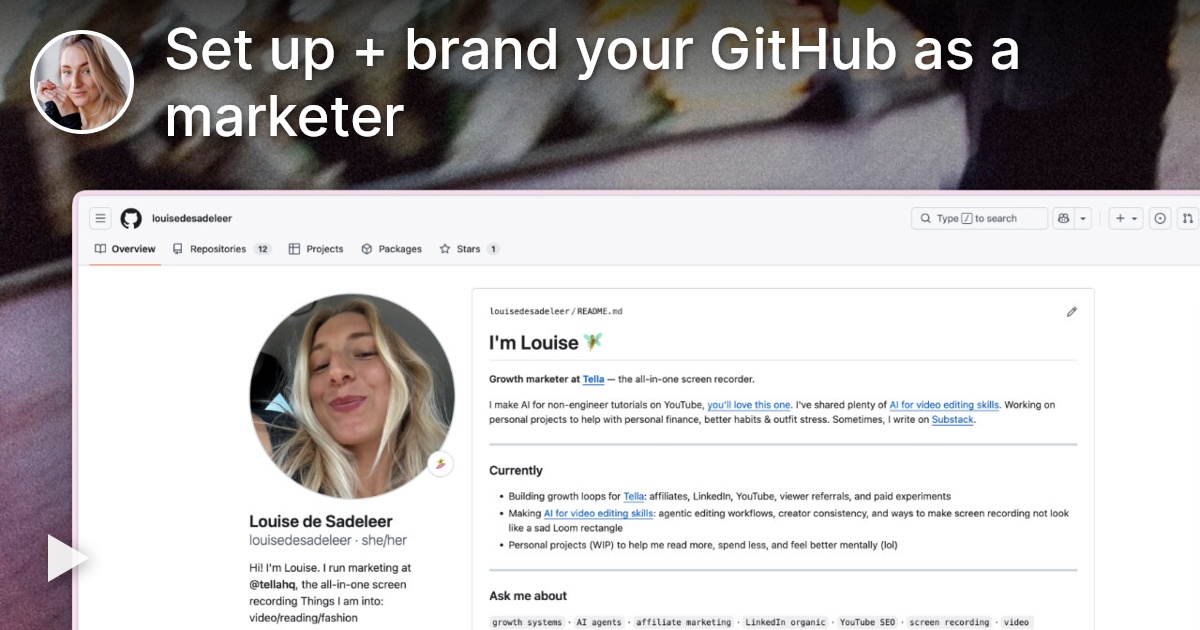
Create an account on GitHub.com
If applicable, ask to be added to your team by an admin.
(Optional) If you'd like to let Claude publish to GitHub directly, install the GitHub CLI. Note: On a Mac, Homebrew is the easiest way to install it. Ask Claude/Codex for installation instructions for your device.
Why GitHub CLI? It lets you tell Claude things like "create a public repo named after my GitHub username with a profile README" and it'll actually run the commands, rather than clicking around the GitHub website.
Create a new public repository named exactly after your username (like this one). Select "Add a README.md" when you do, or ask Claude to do this for you.
This generates a README.md (i.e. markdown file) that you can fill in as an "About" section that'll show up on your profile automatically.

Update the README.md for this repository with information about yourself. You can do this manually via the "✏️" icon or edit through Claude.
Keep the description short and tangible. No LinkedIn-esque bullshit. Here's mine as an example:
"Growth marketer at Tella — the all-in-one screen recorder. I make AI for non-engineer tutorials on YouTube, you'll love this one. I've shared plenty of AI for video editing skills. Working on personal projects to help with personal finance, better habits & outfit stress. Sometimes, I write on Substack."
My thinking is that, for marketers, GitHub acts as a personal landing page replacing a portfolio. So, link to meaningful work or places (e.g. YouTube, X, TikTok) for people to see more from you. Your description should include: where you work, where you post, and what you're into.

Customize your profile homepage.
Connect your socials by adding links (in left side-bar), update the short bio, and add your profile picture.
Optional: Set a fun status. Mine says "gone surfing".
If you have any, pin your repositories (i.e. code) to your profile
I pinned the ones that got the most stars. This skill that turns long-form videos into short-form social clips got 450+ stars.
When you publish a new repo (e.g. a Claude skill, app, markdown file), give Claude a certain format to follow.
I always include a cover photo, a description of the code/project, and what problem I'm solving. Your code will mostly be used by non-technical people, so make sure they understand how to navigate your repo best.
Tell Claude to include installation instructions for non-technical people. I like to include explainer videos, gifs, or workflow diagrams. You can simply tell Claude or Codex to generate diagrams or motion graphics like these:

Distribute your repos and get GitHub stars.
I went viral on X with a few of the skills listed on my GitHub. This meant that people starred the repository or "forked" my code (i.e. made their own copy to build on). The more helpful code and projects you share, the more people will follow you to stay up to date.
